The signs that it’s time to replace your propeller
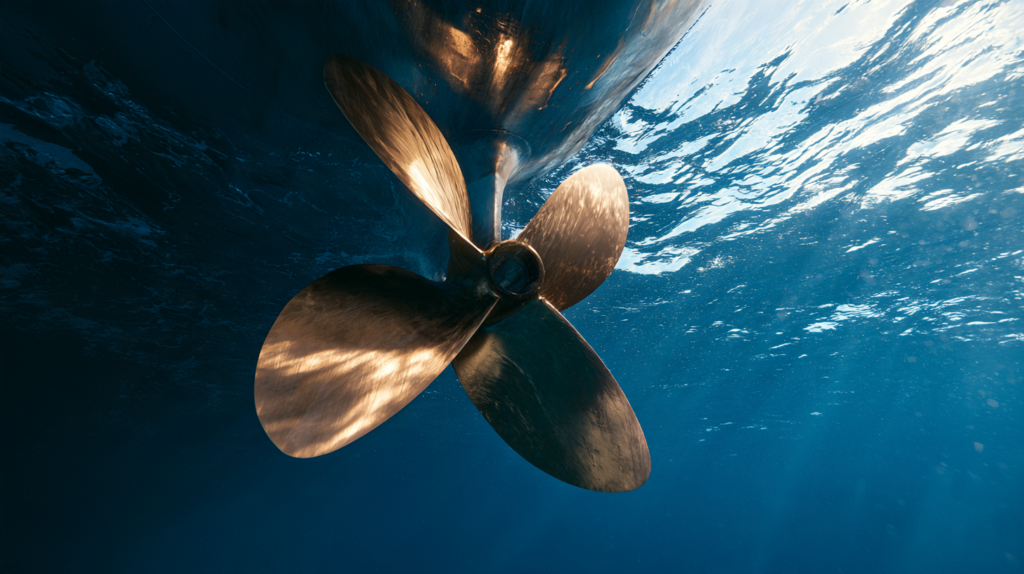
The propeller is one of the fundamental components of the propulsion system: it turns the engine’s power into thrust and allows the boat to move forward. Because it is underwater, however, it isn’t always easy to notice that something isn’t working as it should. An impact, a deformation, wear or cavitation can change how it works and, as a result, how the boat behaves.
So what are the signs to watch for?
- Unusual vibrations
A vibration that wasn’t there before, especially if it appears after an impact, is a sign not to be overlooked. A damaged propeller or a deformed blade can compromise the regularity of rotation and generate vibrations that are transmitted to the shaft and the hull. The cause, however, is not necessarily the propeller: the transmission, mounts, shaft alignment or the engine may also be involved. For this reason, when an abnormal vibration appears, it is important to identify its origin before taking action.
- The boat no longer behaves as it used to
A change in its usual performance can also be a warning bell. Does the boat take longer to get on the plane? Does it no longer reach its usual speed? Is the engine behaving differently from normal? In these cases it is worth checking the propeller too: engine speed, performance and propeller characteristics are in fact closely linked and must be compatible with the boat’s configuration. What matters, then, is not only that the propeller keeps turning, but that it manages to convert the available power into thrust correctly.
- Fuel consumption has increased
A change in fuel consumption can have many causes: sea conditions, load on board, hull condition, cruising speed and engine condition. If, however, under the same conditions consumption rises compared with usual levels, it is worth checking the propulsion system as well. A damaged or no longer suitable propeller can in fact affect the efficiency with which the engine’s power is converted into thrust.
Damage and cavitation: what to look for on the blades
A propeller doesn’t have to be broken to be compromised. Contact with the seabed or with a submerged object can deform a blade or change its profile, even in an apparently minor way. After an impact, therefore, it is advisable to have the propeller checked, even if it keeps working. Another phenomenon to consider is cavitation. Under certain conditions of pressure and speed, vapour bubbles can form around the blades during rotation. Their subsequent collapse can cause small impacts on the surface of the material and, over time, lead to erosion. The presence of small craters or other alterations on the surface of the blades therefore deserves a technical check to determine their origin and assess the condition of the propeller.
Monitoring to understand what is changing
To spot changes of this kind, comparing data over time can be a valuable aid. Orizon, the smart monitoring platform developed by Cartello, collects and analyses the boat’s main operating parameters, creating a history that allows current behaviour to be compared with usual behaviour. An increase in fuel consumption, therefore, does not automatically indicate a propeller problem, but may represent a signal worth investigating, especially when observed together with other changes in the boat’s behaviour.
Repair or replace?
Not every damage makes a new propeller necessary. Depending on the type and extent of the problem, it may be possible to restore the component. In other cases, replacement may be the most appropriate solution. When it comes to replacing it, however, the best choice is not necessarily to simply buy a propeller identical to the previous one. Diameter, pitch, number and geometry of the blades must be chosen according to the engine, the transmission, the hull and how the boat is used. The needs of a boat used mainly for cruising may be different from those of a vessel that frequently sails at high speed. The choice must therefore take into account the real characteristics of the boat and the conditions in which it operates. Replacement can thus also become an opportunity to check whether the propulsion setup is still the most suitable one.
Propeller design
This is where design and experience become essential. Nakashima Propeller, distributed by Cartello, develops propulsion solutions for pleasure craft as well, working on blade geometry and load distribution in relation to the characteristics of the vessel and how it is used. The aim is therefore not only to have a propeller that is compatible with the boat, but a solution designed to work correctly within its propulsion system.
An efficient propeller is not simply a propeller that turns: it is a component designed to convert the engine’s power into thrust in the right way, in relation to the boat and how it is used. For this reason, when vibrations, performance or fuel consumption change, it is worth not stopping at the symptom but understanding what is really happening to the propulsion system.
Have you noticed any of these signs on your boat? Contact the Cartello team for an analysis of the condition of your propulsion system or to find the Nakashima propeller best suited to your setup.