How to avoid the most common breakdowns during a boating holiday
It’s August, you’re at anchor, you’ve just switched off the engine and everything seems to be working perfectly. A few hours later it’s time to set off again, but the engine won’t start. It’s one of those problems that can turn a day at sea into a long wait for assistance. Yet, in many cases, the problem doesn’t begin at that moment: the battery had already started to lose efficiency, a filter was already partially clogged, or a part of the cooling system was already showing the first signs of wear. Many breakdowns, in fact, are not sudden. They are the result of a problem that develops over time and that, if spotted early, can be dealt with before it compromises navigation.
During the summer season, when boats are used more often and for longer periods, maintenance and monitoring therefore become essential to reduce the risk of problems at sea.
The most common breakdowns during holidays
Battery: when the engine won’t start
A battery that can’t start the engine is one of the most common problems, and also one of the most underestimated. The fact that it can still power the on-board instruments doesn’t necessarily mean it is in good condition for starting. Reduced capacity, long periods of inactivity, incorrect charging cycles or problems with the charging system can gradually compromise its performance. Before the season, it is therefore important to check its condition, check the voltage and connections, and make sure the charging system is working properly.
Overheating: a warning sign not to ignore
An abnormal rise in engine temperature can have several causes: a blocked sea water intake, a worn impeller, a problem in the cooling circuit or a belt that isn’t working properly. These situations can start as an apparently minor anomaly and become more serious if the problem is ignored. That is why maintenance must also include the components that ensure the engine is properly cooled, checking their condition and operation before setting off on a long passage.

Filters and fuel
An engine that loses power, runs unevenly or stops while under way may have a fuel supply problem. Dirty filters or contaminated fuel can compromise the system and, in some cases, damage more delicate components. Replacing the filters at the intervals specified by the manufacturer and checking the condition of the fuel are therefore important operations, especially after long periods of inactivity.
Don’t wait for the breakdown: watch for the signs
A check carried out before departure is essential, but it doesn’t necessarily tell you how the boat will behave after days or weeks of use. A battery can gradually lose capacity. An engine’s operating temperature can start to change. A parameter can slowly drift away from its usual values without immediately reaching an alarm threshold. It is precisely these variations that can provide valuable information. That is why preventive maintenance is evolving towards an increasingly data-based approach: not just checking whether a component works, but observing how it is working over time.
Remote monitoring makes it possible to collect information on how the boat is performing even when nobody is on board. The real value, however, is not simply having more data. It is being able to compare the data collected over time and to recognise any changes from usual behaviour. This is the principle behind predictive diagnostics: identifying signs that may indicate an anomaly or deterioration before they turn into a breakdown.
Orizon: monitoring to act sooner
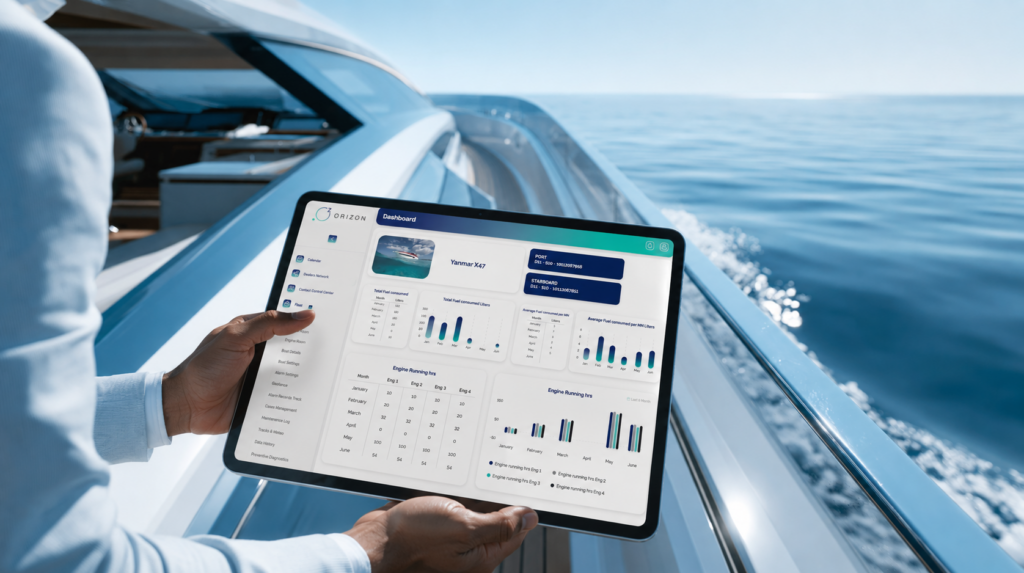
It is on this very principle that Orizon was created, the platform developed by Cartello for smart boat monitoring. Orizon collects and analyses engine and boat operating data, combining remote monitoring and predictive diagnostics. Analysing real-time data and historical records makes it possible to identify changes and abnormal behaviour that may indicate a problem. The aim is not to wait for the engine to stop before taking action, but to have useful information to act before an anomaly turns into time out of service. For an owner, this means greater awareness of the condition of their boat even when they are not on board. For those managing a fleet, it means being able to monitor several vessels at the same time and plan technical interventions based on the actual condition of the boats.
The pre-departure checklist: 15 minutes that can make a difference
Before casting off, a few minutes are enough for a basic check. It doesn’t replace scheduled maintenance, but it can reveal some of the most obvious anomalies.
Engine:
- Check the oil level.
- Check the coolant level.
- Check the belts and visible components.
- Make sure there are no abnormal leaks.
Power and electrical system:
- Check the condition and voltage of the batteries.
- Check terminals and connections.
- Check that charging works properly.
- Switch on the instruments and check for any alarms.
Cooling and bilge:
- Check that the sea water intakes are clear.
- Check that the bilge pumps work properly.
- Check for any leaks or abnormal accumulations of water.
Engine fuel supply:
- Check the fuel level.
- Check for any signs of contamination.
- Make sure the filters have been replaced at the recommended intervals.
If any of these checks reveals an anomaly, it is better to look into it before setting off rather than wait for it to show up while under way.
A holiday without surprises starts before you leave the port
A breakdown during the holidays doesn’t just mean having to repair a component: it can mean a change of route, a long wait for assistance or the loss of a day at sea. Scheduled maintenance remains the first tool for keeping the boat in good shape. Today it is joined by monitoring systems that provide a continuous view of on-board conditions and help to spot any anomalies more quickly. Because peace of mind at sea doesn’t depend only on what to do when something breaks: it depends above all on how soon you notice that something is starting to change.