Diesel outboard engines: diesel fuel costs more, but is it really worth it?
“If diesel costs more than petrol, why choose a diesel outboard?”
It’s a question we have been asked several times during the latest Genoa Boat Show, especially when comparing the running costs of two types of engine. If the price of diesel is the same as or higher than that of petrol, choosing a diesel engine can seem not very cost-effective. But the price per litre doesn’t tell the whole story: to understand how much you really spend, you also need to consider fuel consumption and the hours of navigation during the year. To give a concrete example, let’s take the Cox Marine V8 300 hp and see how costs change in a simulation that compares a diesel outboard with a petrol one of the same power.
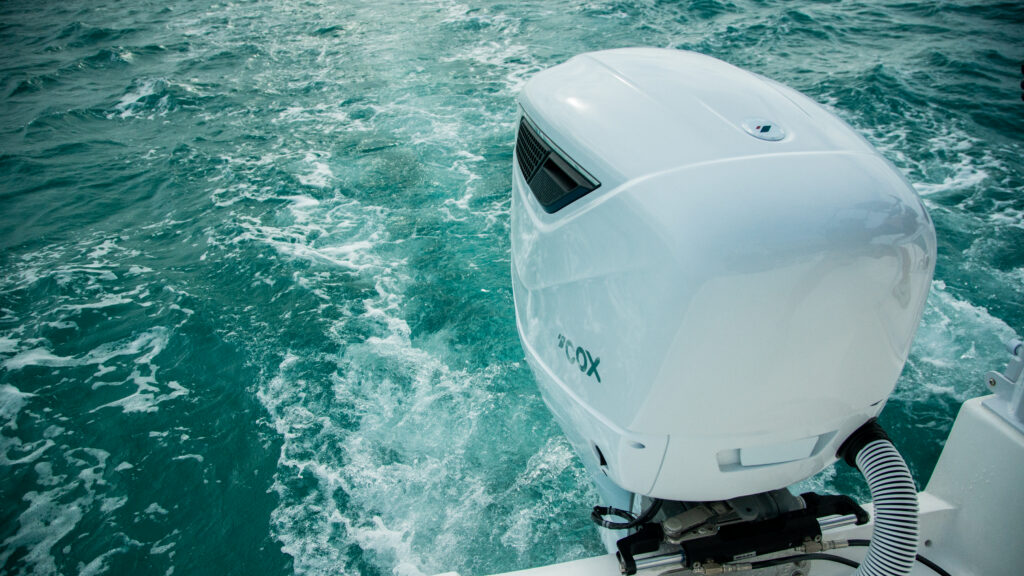
Cox Marine V8: how much does it consume?
The technical data sheet for the Cox Marine V8 300 hp states a consumption of 72 litres per hour. For a petrol outboard of the same power, the reference value given is 98 litres per hour. The difference is 26 litres for every hour of operation: in terms of volume, the diesel’s consumption is therefore about 26.5% lower. These figures should nevertheless be read with care. They are based on sea trial data, but we have no confirmation that the two engines were tested under exactly the same conditions. In practice, consumption also depends on the type of boat, the load, the sea state, the cleanliness of the hull and the propeller used. The data nevertheless offer a reference point for understanding why the price of fuel alone is not enough to determine which engine is more cost-effective.
How much does an hour of navigation cost?
For an economic comparison, we use the prices published by Porto Romano, the marina in Fiumicino, which on 18 September 2026 listed diesel at €2.55 per litre and petrol at €2.40 per litre.
Applying these prices to the consumption figures in the data sheets, the result is as follows:
- 300 hp petrol outboard: 98 l/h × €2.40/l = €235.20 per hour
- Cox Marine V8 300 hp diesel: 72 l/h × €2.55/l = €183.60 per hour
In this scenario, the difference is €51.60 for every hour of operation in favour of the diesel.
Diesel costs more per litre, but the lower volumetric consumption makes up for the price difference. It is worth remembering that this is a theoretical calculation: prices can change from one port to another and actual consumption depends on navigation conditions. Moreover, the comparison does not prove that the two engines consume under the same test conditions.
How long does it take to recover the initial cost?
The fuel saving is only part of the comparison. To choose between two engines, you also need to consider the purchase price and any additional costs for installation and accessories. Let’s assume, by way of example, that the diesel solution involves an initial outlay €40,000 higher than the petrol one. Using the theoretical saving of €51.60 per hour calculated above, it would take about 775 hours of operation to recover the difference. This is a simplified simulation that considers fuel only. For a complete assessment, you would also need to add maintenance costs, spare parts and any difference in the residual value of the engines. The time needed to recover the investment therefore depends mainly on how much the boat is used.
How many hours a year do you sail?
Assuming usage of about 250-300 hours a year, about 2.5-3 years would be needed. The more hours you sail, the more fuel consumption can affect the overall cost-effectiveness of the engine. For those who use the boat only for a few weekends or summer holidays, recovering a higher initial outlay could take many years. For those who use the engine more frequently, on the other hand, the fuel saving can become a more significant item.
It’s not just a question of cost
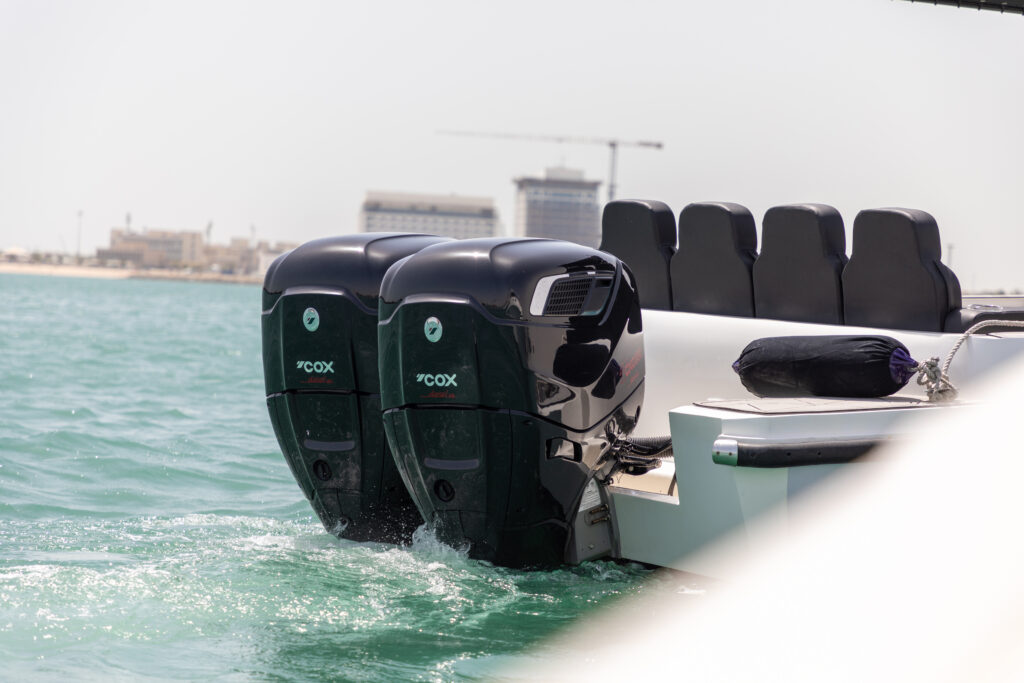
The choice of a diesel outboard can also depend on technical and operational needs, which vary according to the type of boat and how it is used.
Torque. The Cox Marine V8 300 hp declares a torque of 998 Nm at the propeller, a significant figure for applications that require high thrust, especially for large boats with heavy loads. It is important to stress that, for the same rated power, a diesel engine can offer significantly higher torque than an equivalent petrol engine, with delivery characteristics that can be comparable to those of a petrol engine of larger displacement and power. Actual performance nevertheless depends on the reduction ratio, the propeller, the characteristics of the hull, the load and the navigation conditions.
Safety on board. Petrol and diesel have different characteristics in terms of volatility and flammability, which are important aspects when assessing fuel management on board. For large yachts, the choice of engine and the way fuel is stowed must take into account the characteristics of the vessel and the applicable regulations.
Fuel management. On some large yachts and on work boats, using the same fuel for the main engines, the generators and the tender can simplify refuelling and stock management. The practical advantage depends on the boat’s configuration and its operational needs.
Range. For the same tank capacity, the lower fuel consumption typical of a diesel engine can allow longer distances to be covered before refuelling, under the same navigation conditions. Alternatively, for the same required range, it is possible to consider installing a smaller tank, with a consequent reduction in the boat’s overall weight and potential benefits in terms of efficiency and performance. The actual range nevertheless depends on speed, load, sea conditions and usage profile.
Diesel or petrol: which is really worth it?
There is no answer that holds for every boat. The price of fuel is an important factor, but it must be assessed together with consumption, the initial cost of the engine and the expected hours of navigation. The example of the Cox Marine V8 300 hp shows how, in the scenario considered, the lower volumetric consumption can offset the higher price of diesel. This does not mean that diesel is always the most cost-effective solution: the result depends on how the boat is used and on all the costs to be borne over time. For those who sail many hours a year, especially in a professional setting, the fuel saving can significantly affect operating costs. On top of this there is a further aspect: marine diesel engines may provide, depending on the model and the manufacturer’s specifications, longer routine maintenance intervals than the corresponding petrol engines. This can help reduce maintenance costs and the time needed to recover any additional initial investment.