Technical insight into propellers: The parameters behind performance

After analyzing the main elements that influence the choice of a propeller, it is useful to examine in greater depth the geometric and functional parameters that determine a propeller’s actual behavior in water.
Characteristics such as rake angle, cup, skew angle, and the various blade area parameters directly affect load distribution, propulsive efficiency, ventilation phenomena, and cavitation. These variables do not act independently; rather, they collectively define the propeller’s operating behavior in relation to the hull, operating regime, and engine characteristics. Let’s, therefore, examine the main parameters used in propeller design and evaluation.
rake
The rake angle is the angle of inclination of the blade relative to a plane perpendicular to the propeller shaft axis.
A positive rake (blades inclined aft):
- modifies thrust distribution by introducing a component that can influence the boat’s longitudinal trim, tending to lift the stern
- improves propeller grip in demanding conditions (turning maneuvers, rough seas)
- may slightly increase engine load, and therefore must be selected in balance with pitch and diameter.
A low rake angle, on the other hand, generally provides greater stability at low speeds, with less stern lift. The overall effect of rake depends on the vessel configuration and the position of the propeller relative to the hull.
cup
The cup is a curvature applied to the trailing edge of the blade. It is a small detail, but one with very significant effects on the boat’s performance.
The cup increases the propeller’s grip on the water and helps prevent the propeller from “slipping” or drawing in air, especially during acceleration or while turning.
The introduction of cup results in:
- an increase in the effective load on the propeller
- a possible reduction in the engine’s maximum RPM with the same configuration
- improved flow retention, particularly during acceleration or under heavy-load conditions.
The cup is typically used as a fine-tuning parameter without modifying the nominal diameter or pitch.
slip
The slip represents the difference between the propeller’s theoretical advance, determined by its geometric pitch, and the actual advance per revolution. It is an operating parameter used to evaluate the real efficiency of the propulsion system.
The slip is generally expressed as a percentage and depends on:
- the vessel’s load conditions
- rotational speed
- characteristics of the incoming flow (wake)
- operating conditions (calm sea, rough sea, presence of air).
The slip should not be considered an eliminable loss, but rather a natural consequence of propeller operation in a real fluid environment. It varies depending on both the type of vessel and the propulsion configuration: outboard, sterndrive, shaft drive, or surface-piercing propellers.
Excessive slip may indicate:
- an incorrect match between pitch, RPM, and load
- the presence of ventilation or cavitation.
Projected Blade Area (PAR)
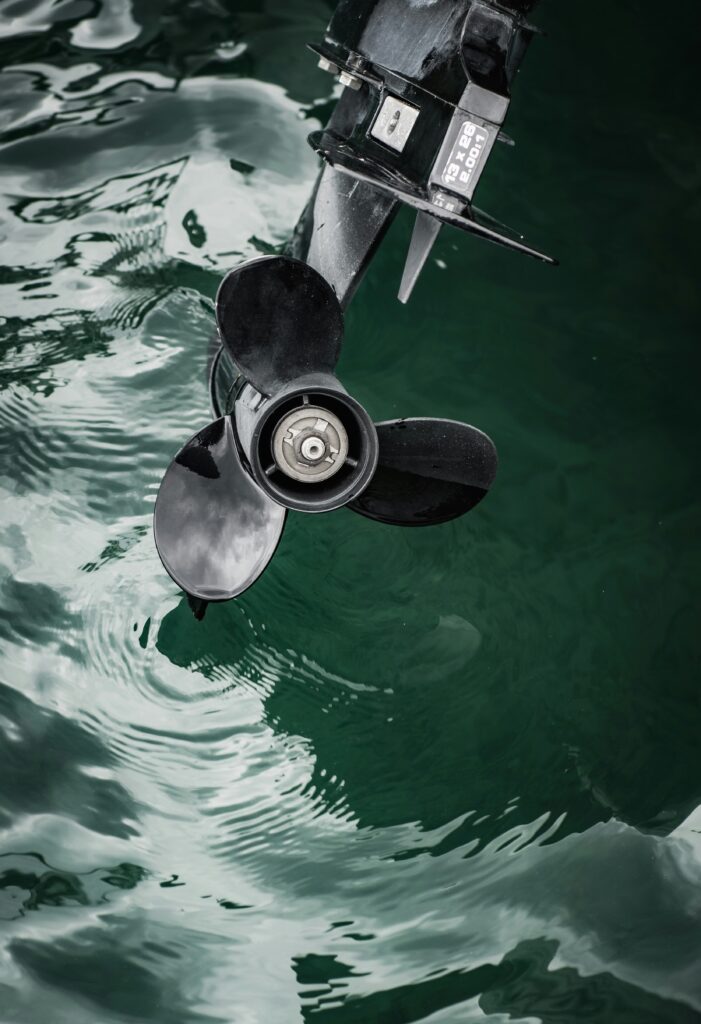
The Projected Blade Area (PAR) is the blade area projected onto a plane perpendicular to the propeller shaft axis — in other words, the projection visible when looking directly at the propeller blade. It represents the surface effectively exposed frontally to the flow and indicates the propeller’s ability to generate thrust.
Developed Blade Area (DAR)
The Developed Blade Area (DAR) is the blade area obtained by geometrically developing the blade surface onto a plane — essentially the area of the blade outline if the blade were detached from the hub and flattened to zero pitch. The DAR is a parameter used to indicate how much “blade material” is distributed within the propeller disc.
Expanded Blade Area (EAR)
The Expanded Blade Area (EAR) is the blade area obtained by projecting the blade onto a cylindrical surface and then developing it onto a plane. In practical terms, it is the blade area after the DAR has been flattened.
It is one of the most commonly used parameters in propeller design because:
- it more realistically represents the blade’s active surface area
- it correlates with the propeller’s ability to absorb power without triggering cavitation.
Blade area parameters (PAR, DAR, EAR) originate from naval design literature and are used to evaluate load distribution and the propeller’s hydrodynamic behavior.
The Cartello approach
The analysis of the main geometric and functional parameters of a propeller highlights how its behavior in water is the result of a complex and interdependent set of variables. Elements such as rake angle, cup, slip, and blade area parameters (PAR, DAR, EAR) do not act independently, but work together synergistically to determine the propeller’s ability to convert engine power into useful thrust.
In this context, it is essential to emphasize that the propeller is not a secondary or merely accessory component of the propulsion system. Rather, it is the true interface element between the engine and the water. It is precisely through the propeller that the engine’s delivered power is transformed into effective propulsive force. Consequently, even with an efficient hull and high-performance engines, an incorrect propeller choice can significantly compromise the vessel’s overall behavior. A propeller that is improperly sized or not optimized for the operating regime, load, and working conditions may generate several negative effects, including:
- increased slip and reduced propulsive efficiency
- more frequent ventilation or cavitation phenomena
- inability of the engine to operate within its correct RPM range
- increased specific fuel consumption
- reduced top speed and acceleration efficiency
- possible engine overload or underutilization.
Conversely, proper propeller design or selection makes it possible to achieve the best balance between thrust, efficiency, and operational reliability, ensuring that the engine operates within its optimal efficiency range and that the available power is effectively translated into real vessel performance.
In summary, the overall performance system of a vessel (engine + propeller + hull + load + operating conditions) does not depend solely on hull quality or installed power, but on the overall balance among all its elements. Within this balance, the propeller represents the determining factor: an excellent boat and powerful engines cannot express their full potential if the propeller is unable to transfer thrust correctly into the water.
For this reason, propeller selection should be considered a fundamental design and operational phase, to be carried out using accurate technical criteria and in direct relation to the vessel’s characteristics and its operating profile. This is where Cartello comes into play: thanks to technicians with decades of experience, the company offers dedicated and personalized consultancy for propeller selection, as well as the possibility of creating highly customized products.